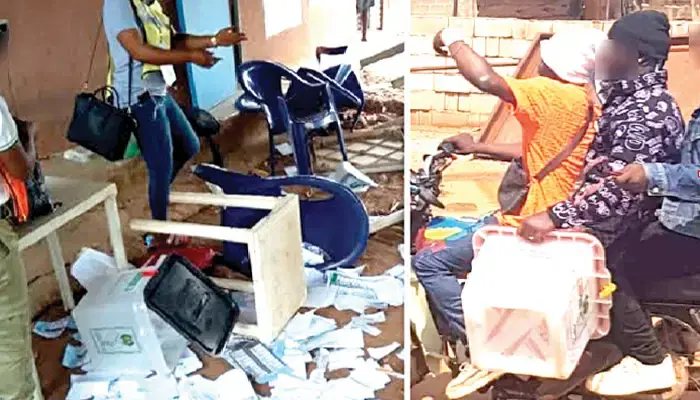
Following the widespread violence and irregularities that marred recent by-elections across several Nigerian states, fears are mounting that the 2027 general elections could become the most chaotic and dangerous in the country’s democratic history. Stakeholders ranging from elder statesmen and legal experts to civil society leaders, political analysts, and former election candidates have issued strong warnings, calling for urgent reforms to safeguard the electoral process and protect national stability.
The stakeholders who spoke with Saturday Vanguard raised concerns over the growing desperation of political actors, the weaponization of poverty, and the systematic failure of the Independent National Electoral Commission (INEC), security agencies, and the judiciary to uphold electoral integrity.
INEC Must Transmit Results Electronically, Not Accept Party-Written Figures
Many respondents, including Furoebi Akene, Chairman of the Centre for Environmental Preservation and Development (CEPAD), and several civil society leaders, emphasized the urgent need for INEC to adopt full electronic transmission of results from polling units to prevent manipulation at collation centers.
Akene described the current electoral system as a "charade," stating that elections in Nigeria are often decided not by the will of the people but by political forces with the power to manipulate both the electoral body and the judiciary.
Prosecute Sponsors, Not Just Thugs – Omenazu, Others Demand
Dr. Jackson Omenazu, Chancellor of the International Society for Social Justice and Human Rights (ISSJHR), stressed that the real culprits of electoral violence are often untouched.
“Until the sponsors of electoral thuggery—those in high political offices—are arrested and punished, this menace will persist,” he said. He called for swift, deterrent punishment for all perpetrators, regardless of status, and for the courts to be empowered to try electoral offenders without interference.
Supporting this position, Zik Gbemre, National Coordinator of the Niger Delta Peace Coalition (NDPC), criticized the judiciary and law enforcement for their lack of action. “Without honest and consequential action against those involved, Nigeria has no hope of achieving free, fair, and credible elections,” he said.
Recent Bye-Election Violence a Red Flag – Northern Groups, Activists
Comrade Jamilu Aliyu Charanchi, National Coordinator of the Coalition of Northern Groups (CNG), said the violence recorded during the recent bye-elections should serve as a wake-up call. “If we see armed thugs and open vote-buying in just 12 states, what will happen in 2027?” he asked, urging INEC and security agencies to act preemptively rather than reactively.
Political activist Blessing Adima urged INEC to reject results from polling units where thuggery is evident, stating that thugs often cart away materials while parties submit forged results that are eventually accepted.
Root Causes: Poverty, Poor Values, and Political Desperation
Legal experts and analysts pointed to deep-rooted issues fueling electoral malpractice. Dr. Akpo Mudiaga-Odje argued that widespread poverty makes it easy for politicians to recruit thugs, turning "stomach infrastructure" into a political weapon. He said: “Until we reduce poverty, thuggery will persist.”
Retired Judge Miakpor Emiaso attributed the violence to an entrenched culture of force, a legacy of military rule, and called for value reorientation beginning at the primary school level.
Call for Electoral Reform and Institutional Accountability
Several contributors urged the fortification of the Electoral Act to close legal loopholes and enable INEC to operate independently. Dr. Tunde Afolabi suggested disqualification and prosecution of vote-buyers, enhanced voter education, and use of technology to monitor and report malpractice.
Waheed Saka, convener of Dialogue 365, warned that despite tools like BVAS and IReV, politicians still find ways to bypass systems through vote trading and violence.
2027 Could Be a Breaking Point for Nigerian Democracy — Observers Warn
From Plateau to Edo, citizens, activists, and observers raised alarm over what the future might hold if current trends continue unchecked. Rev. Johnny Aikpitanyi, PDP candidate in the recent Ovia Federal Constituency by-election, described scenes of vigilantes and thugs dominating polling units, accusing the ruling party of using intimidation to suppress voters’ will.
In Ekiti, Lanre Ogunsuyi, a communication strategist, emphasized the need to reform electoral institutions and instill greater voter ownership through education and technology. “Perpetrators of electoral violence and their sponsors must be held accountable,” he said.
Security Agencies Urged to Act Without Bias
Stakeholders across the board called on security agencies to act impartially, proactively, and professionally during elections. Dr. Ken Robinson, former PANDEF spokesperson, said, “Security forces must arrest not only the thugs but also their enablers and political godfathers.”
Journalists and civil society leaders from Plateau also echoed this demand, calling for tougher enforcement and caution ahead of 2027 to prevent chaos.
Conclusion: Democracy or Disaster?
The overwhelming message from stakeholders is clear: without urgent reforms, real consequences for electoral offenders, and a sincere commitment from political leaders, security agencies, INEC, and the judiciary, Nigeria’s democracy faces a potentially catastrophic test in 2027.
As Samuel Adeyemi noted, “If these trends remain unchecked, the future of democracy in Nigeria is at serious risk.”
Leave a comment
Your email address will not be published. Required fields are marked *